
Batavia Address History Sources
No single roll names every person who occupied a Batavia property. The strongest backward trail combines title records with sources made for other purposes. A deed identifies a recorded owner and land. A directory places a named person at a printed address in a stated year. Census, newspaper, probate, cemetery, map, and structure files then test whether those two trails belong together. The table marks the known local coverage without implying that every year or image is online.
| Batavia source | Known years | Where to consult it | Evidence it adds |
|---|---|---|---|
| Kane land records | Archive described from 1837; online image cutoff not stated | Kane County Recorder and Land Records Search | Grantor, grantee, instrument, PIN, plat, and legal description |
| DuPage land records | Online documents and images from March 16, 1961 | DuPage County Recorder | Transfers for parcels in Batavia's DuPage portion |
| Local directories | 1857 and 1859-60 material; Tri-City run from 1910 to present | Historical Society and Public Library | Dated names, addresses, occupations, and household clues |
| Telephone books | 1916-1956 at the library | Batavia Public Library Local History Room | Subscriber and address evidence between directory years |
| Census microfilm | Selected Kane schedules, 1840-1930 | Batavia Public Library | Household members and relationships for listed census years |
| Structure and map files | 1916 Sanborn sheets and undated local structure histories | Library of Congress and Gustafson Research Center | Lot, building form, use, and continuity of the address |
For a recent search, begin with the assessor and deed index. For an early twentieth-century question, start with the exact directory year, then compare the census and a Sanborn sheet. Nineteenth-century work often needs the Historical Society, Recorder counter, library, or IRAD rather than a web search. Each finding should retain its publication year, page, instrument number, or file reference.
Find Batavia's First Address Listing
Copy the address exactly as it appears in the oldest known family paper, directory, deed, newspaper notice, or photograph caption. Do not modernize it at first. Early records may identify Batavia as a township, village, rural route, or Kane County place. The city was incorporated as a village in 1856 and as a city in 1891, so the place label itself can help date the clue.
The Batavia Public Library Local History Room holds Tri-City directories from 1910 to the present, telephone books from 1916 through 1956, selected census microfilm, newspapers, atlases, cemetery guides, and other aids. The Gustafson Research Center reaches earlier with 1857 and 1859-60 directory material, family files, maps, structure histories, and probate material. These are holdings descriptions, not a promise that every volume is searchable online.
Record the spelling, year, page, and type of listing. “Listed at” is more exact than “lived at” until another source agrees.
Walk Back Batavia Deeds
The present parcel card supplies the PIN, owner or billing name, situs address, and legal description. A situs address is the land's location; the mailing address is where the tax notice goes. They may differ. Use the county field in City or Kane GIS because a Batavia mailing address can fall in Kane or DuPage County.
- Find the current parcel through Kane DevNet, or use DuPage Property Records for a DuPage parcel. Save its PIN and legal description.
- Search the present owner's purchase in the Kane Land Records Search. Note the grantor, recording date, instrument number, and document type.
- Search that seller as a grantee. The deed by which the seller acquired title should identify the prior grantor.
- Repeat the grantee-to-grantor handoff. Compare the legal description at every step so a same-name person or nearby lot does not enter the chain.
- When images or indexes stop online, take the instrument, tract, subdivision, and date to the Recorder's public computers or staff. Older access may require an office copy.
- Grantor and grantee
- The grantor transfers an interest; the grantee receives it.
- Chain of title
- The dated sequence of documents that passes ownership from one party to the next.
- Legal description
- The lot, block, tract, or metes-and-bounds wording that identifies land more reliably than an old street number.
Kane's Recorder describes its property archive as reaching 1837, but the portal does not state one simple historical image cutoff. On the DuPage side, online indexed documents and images begin March 16, 1961. Those different access points make the county check essential.
Test Batavia Houses Against Maps
A deed can continue across a demolition, lot split, or new structure. Match the title trail to physical evidence before assuming the same house stood through the whole period. The Library of Congress has a 1916 Batavia Sanborn set with fifteen sheets. Sanborn maps can show a building footprint, materials, use, and nearby landmarks. They do not name all previous residents.
Structure histories and abstracts at the Gustafson Research Center add local detail. Plats and atlases can preserve lot and block numbers when a street label fails. No verified citywide Batavia street-renumbering project was found in the research, so never invent a number change to explain a mismatch. Carry the old form forward, compare legal descriptions, and ask the library or Historical Society about the specific street.
Note: A modern geocoder's failure does not disprove an old Batavia address; lot, block, structure, and dated map evidence may still align.
Bridge Batavia Directory Gaps
A missing name in one volume is not proof of absence. The book may be missing, the resident may have moved between canvass and publication, the entry may use initials, or optical character recognition may have read the scan poorly. Pair the nearest directory on each side of the gap with census, newspaper, city minutes, family-history, tax, or land evidence.
A useful flow is: dated directory address → nearest available census schedule → newspaper or obituary → deed and structure record. Keep each source's date separate. Batavia Public Library lists selected Kane census microfilm for 1840, 1850, 1860, 1870, 1900, 1910, 1920, and 1930. A directory between census years can narrow the time when a household appeared or left.
The full shelves and entry-reading method belong to the Batavia city directory collection. Here, use only the volumes that test the address timeline.
Follow Batavia Families Beyond Departure
Probate, obituaries, cemetery guides, and genealogy indexes can explain why a name disappears. The Kane genealogy portal reports birth records from 1855, deaths from 1866, and marriages from 1836, with access controlled by age and eligibility rules. Its captured online coverage reaches births through 1927, marriages through 1962, and deaths through 1992. Search variants and Soundex can help with spelling, but an index hit must still be checked against the image or ordered record.
The Kane Circuit Clerk and IRAD are the fallbacks for wills, probate, and older court files. IRAD offers mail and phone research with a two-name limit, while the Circuit Clerk genealogy counter requires photo identification for research access. Batavia newspapers at the library and digitized local collections can supply relatives, a former address, funeral information, or a move. No universal official Batavia obituary or cemetery index was located.
The City manages East and West Batavia Cemeteries. The cemetery information page gives the official contact route, but not an online interment search.
The successful manifest capture below shows the Kane genealogy service's own coverage guidance and search cautions.
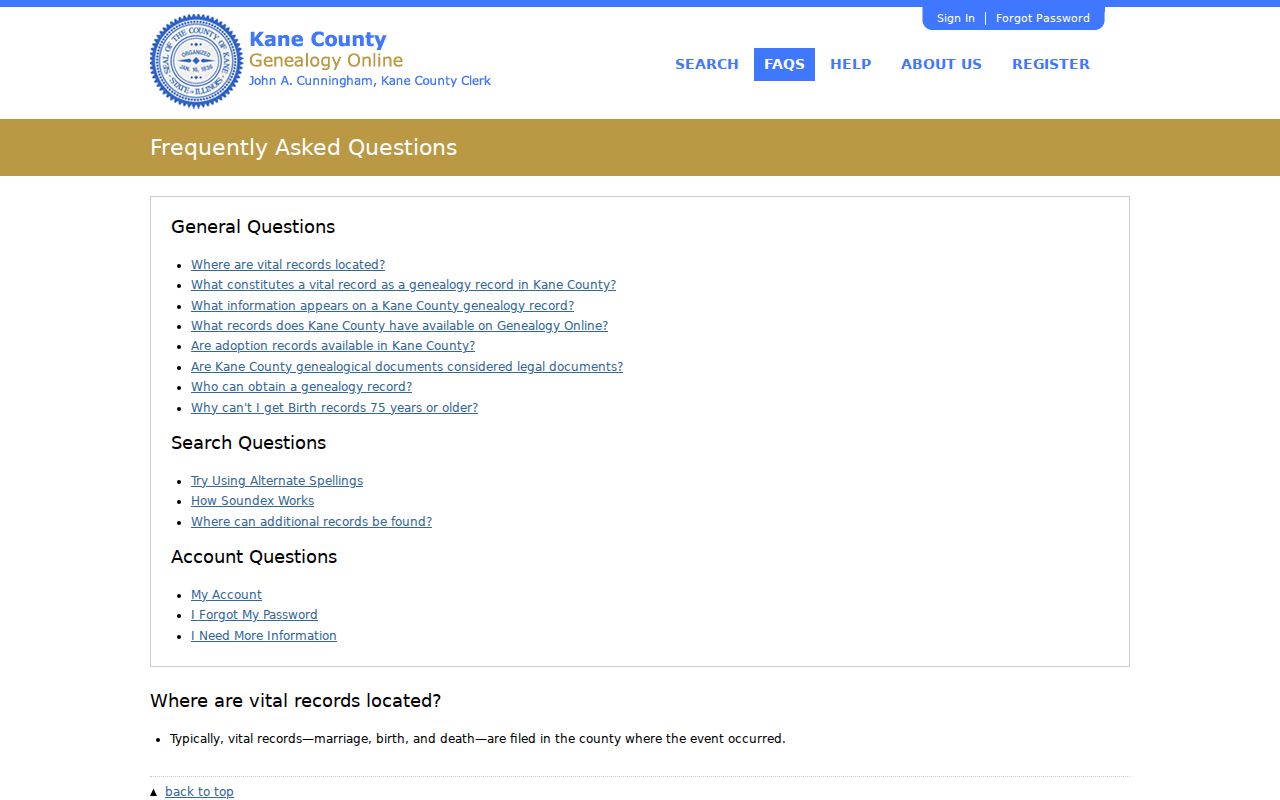
Its rules make clear why a surname result is a lead, not unrestricted access to a recent certificate.
The City also publishes the official route for cemetery questions and site information.
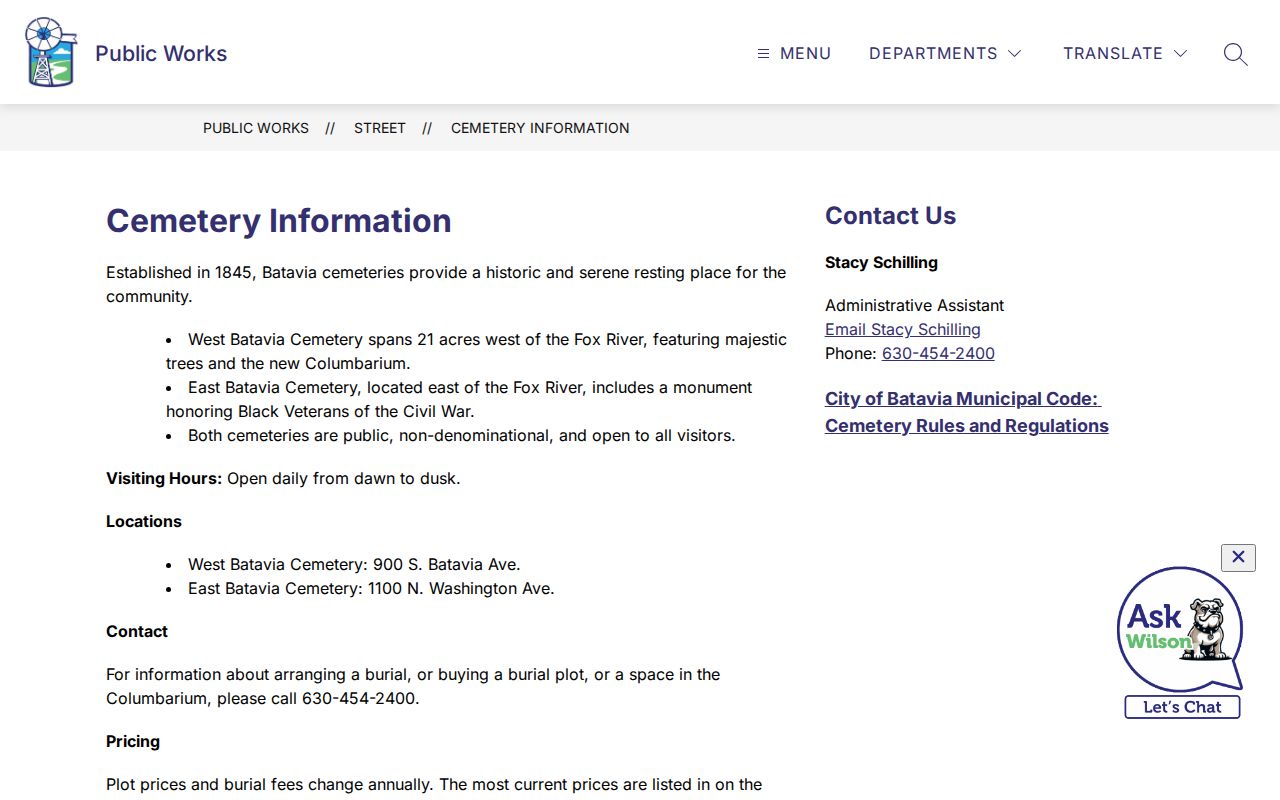
That page supports a custodian inquiry when a cemetery guide or obituary supplies a likely Batavia burial but no online interment result exists.
Batavia Records Span Two Centuries
Batavia's previous-resident trail has unusual depth but no unbroken master index. The Historical Society's 1857 and 1859-60 material comes before the library's Tri-City directory run, which starts in 1910. Telephone books, newspapers, census schedules, structure histories, and deeds cover different gaps. Kane's property archive claim reaches 1837, one year after the county was organized.
This long span is the page's useful numbers story. It is also a warning about access. An archive start date does not mean every record survives, carries a Batavia street address, or has a digital image. Preserve the source year and access condition. If an online search fails, try the Recorder counter, library local-history room, Historical Society, Circuit Clerk, or IRAD with a narrow name, address, and date range.
Confirm Batavia Past Households
Ownership and occupancy answer different questions. A tax roll can name an owner whose mailing address is elsewhere. A directory or census can list past residents who never owned the land. Put both lines on one dated timeline, but label every item by what it proves: “recorded owner,” “directory listing,” “census household,” or “named in obituary.”
When the evidence agrees, the case grows stronger. When it conflicts, keep both entries and look for a move, estate transfer, lot split, or address variant. Never merge people solely because they share a surname. For living people, omit a compiled bundle of address, phone, and family details.
Lawful use. Research Batavia previous residents for family history, estate work, or the history of a house. Never use the trail to track, intimidate, or harass a living person.